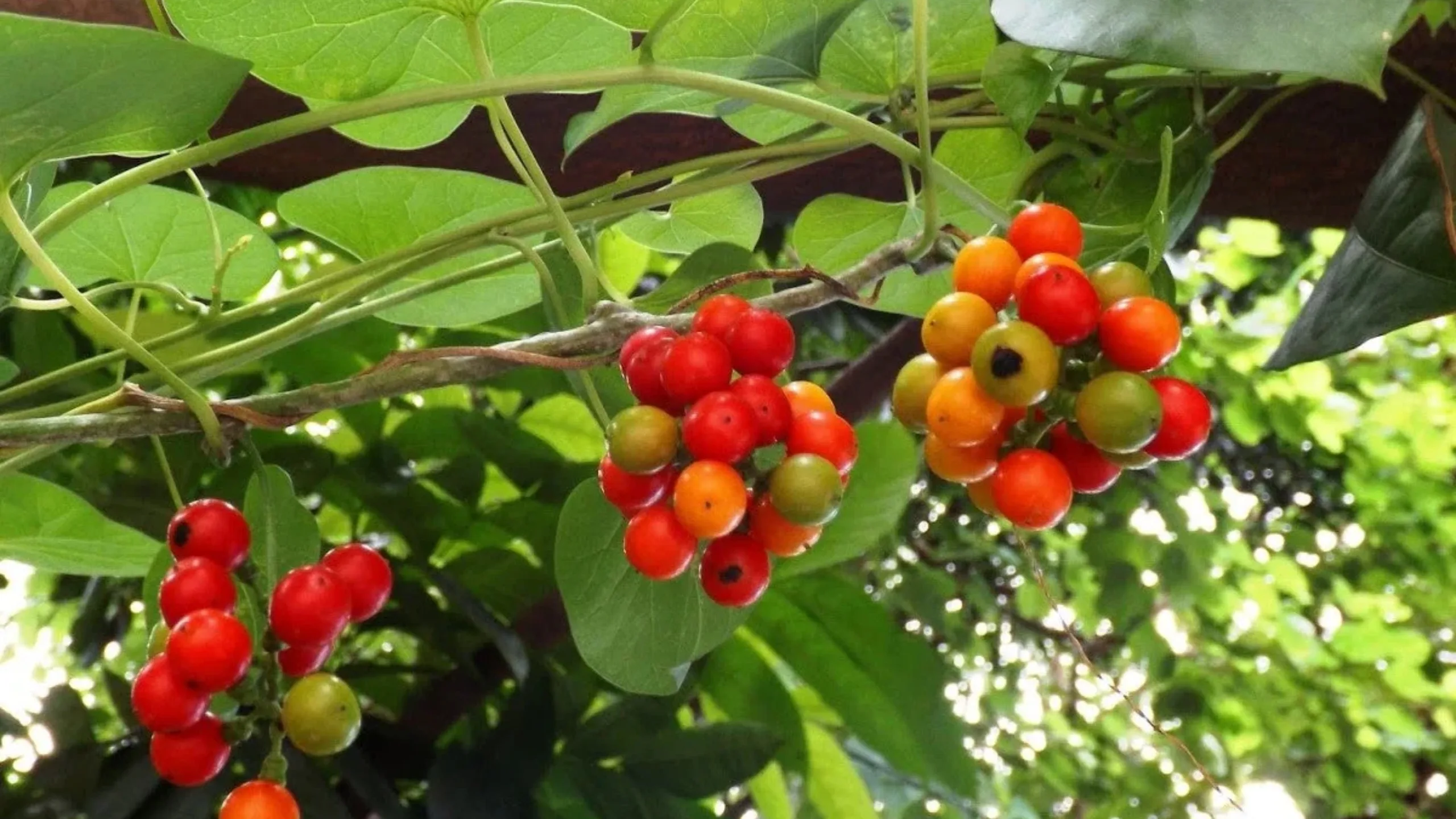
Guduchi, commonly known as Giloy, is a perennial climbing plant belonging to the Menispermaceae family. Its accepted botanical name is Tinospora cordifolia (Willd.) Hook.f. & Thomson. It is native to the Indian subcontinent and has a long history of use in Ayurveda and other traditional Indian medicinal practices. The stem is one of the commonly used plant parts in traditional preparations. Guduchi contains naturally occurring alkaloids, diterpenoid compounds, glycosides, polysaccharides, and other phytochemicals that have been studied for various biological activities.
GUDUCHI Scientific Name
- Kingdom: Plantae
- Clade: Angiosperms
- Clade: Eudicots
- Order: Ranunculales
- Family: Menispermaceae
- Genus: Tinospora
- Species: Tinospora cordifolia
GUDUCHI Common Name
- English: Indian Tinospora, Heart-leaved Moonseed
- Sanskrit: Guduchi, Amrita, Amritavalli
- Hindi: Giloy
- Gujarati: Galo
- Tamil: Seenthil Kodi
- Telugu: Tippa Teega
- Malayalam: Amruthu
- Bengali: Gulancha
- Marathi: Gulvel
Traditional Uses of Guduchi
Traditional Immune and Wellness Use:
Guduchi has a long history of use in Ayurveda and is traditionally included in herbal preparations for general wellness and immune-related support. Traditional use should not be interpreted as proof that Guduchi prevents or treats infections.
Traditional Fever-Related Use:
Guduchi has traditionally been used in Ayurvedic preparations associated with fever and general recovery. Evidence from traditional practice should be distinguished from modern clinical evidence for specific types of fever.
Traditional Joint and Inflammatory Use:
Guduchi is traditionally used in some herbal preparations associated with joint and inflammatory health. Research has investigated different extracts of the plant for biological activities, but this does not establish Guduchi as a treatment for arthritis or other inflammatory diseases.
Traditional Blood Sugar Research:
Guduchi extracts have been investigated in experimental research for effects related to
glucose metabolism. These findings should not be presented as evidence that Guduchi treats or controls diabetes in humans.
Phytochemical Constituents
Guduchi contains a variety of naturally occurring phytochemicals. Reported constituents include:
- Alkaloids: Berberine, palmatine, magnoflorine and related alkaloids.
- Diterpenoid compounds: Tinosporide, tinosporon and other reported diterpenoid constituents.
- Sterol compounds: β-Sitosterol and other plant sterols.
- Glycosides: Various glycosidic constituents reported in different plant parts and extracts.
- Polysaccharides: Polysaccharide fractions, including arabinogalactan-type compounds, have been investigated in experimental studies.
- Phenolic and other compounds: Guduchi also contains phenolic compounds, flavonoids and other secondary metabolites.
The phytochemical profile can vary depending on the plant part, growing conditions and extraction method.
Which Part of Guduchi Is Traditionally Used?
The stem of Tinospora cordifolia is commonly used in Ayurvedic herbal preparations, although other plant parts have also been described in traditional literature. The specific plant part and preparation method can influence the phytochemical profile of the final herbal product.
Safety and Precautions
Guduchi should be used according to the formulation, product instructions or guidance from a qualified healthcare professional. Traditional use and laboratory research do not automatically establish safety or effectiveness for every medical condition. People with existing medical conditions, those taking regular medicines, pregnant or breastfeeding individuals, and children should seek appropriate professional advice before using concentrated Guduchi preparations. Stop use and seek medical attention if an unusual or concerning reaction occurs.
References
Ayurvedic Pharmacopoeia of India (API) – Government of India, Ministry of AYUSH. Volume I, Part I, Monograph No. 34
Sharma, P.V. (1981). Dravyaguna Vijnana (Vol. II). Chaukhambha Bharati Academy, Varanasi.
Singh, S.S., Pandey, S.C., Srivastava, S., Gupta, V.S., Patro, B., & Ghosh, A.C. (2003). "Chemistry and medicinal properties of Tinospora cordifolia (Guduchi)." Indian Journal of Pharmacology, 35, 83–91.
Nadkarni, K.M. (1976). Indian Materia Medica. Vol. 1. Bombay: Popular Prakashan.
Chopra, R.N., Chopra, I.C., Handa, K.L., & Kapur, L.D. (1958). Indigenous Drugs of India. 2nd Ed. Calcutta: UN Dhur and Sons.
Sharma, R. (2012). "Immunomodulatory properties of Tinospora cordifolia and its role in COVID-19-like viral infections: An Ayurvedic perspective." Journal of Ayurveda and Integrative Medicine, 3(4), 141–145.
Indian Pharmacopoeia Commission. Indian Pharmacopoeia (IP), Government of India. Ghaziabad.
World Health Organization (WHO). (1999). Monographs on Selected Medicinal Plants, Vol. 1.
Frequently Asked Questions
What is Guduchi?
Guduchi is an Ayurvedic herb botanically known as
Tinospora cordifolia, commonly called Giloy.
What is the botanical name of Guduchi?
Its accepted botanical name is
Tinospora cordifolia (Willd.) Hook. f. & Thomson.
Which part of Guduchi is commonly used?
The stem is one of the commonly used parts in traditional Ayurvedic preparations.
What compounds are found in Guduchi?
Guduchi contains alkaloids, diterpenoid compounds, glycosides, sterols, polysaccharides and other phytochemicals.
How is Guduchi traditionally used?
Guduchi has traditionally been included in Ayurvedic preparations for general wellness and various health-related purposes.
Content by: Polycare Herbals Editorial Team
Specialization: Ayurvedic and Herbal Wellness Information



 My Account
