



 My Account

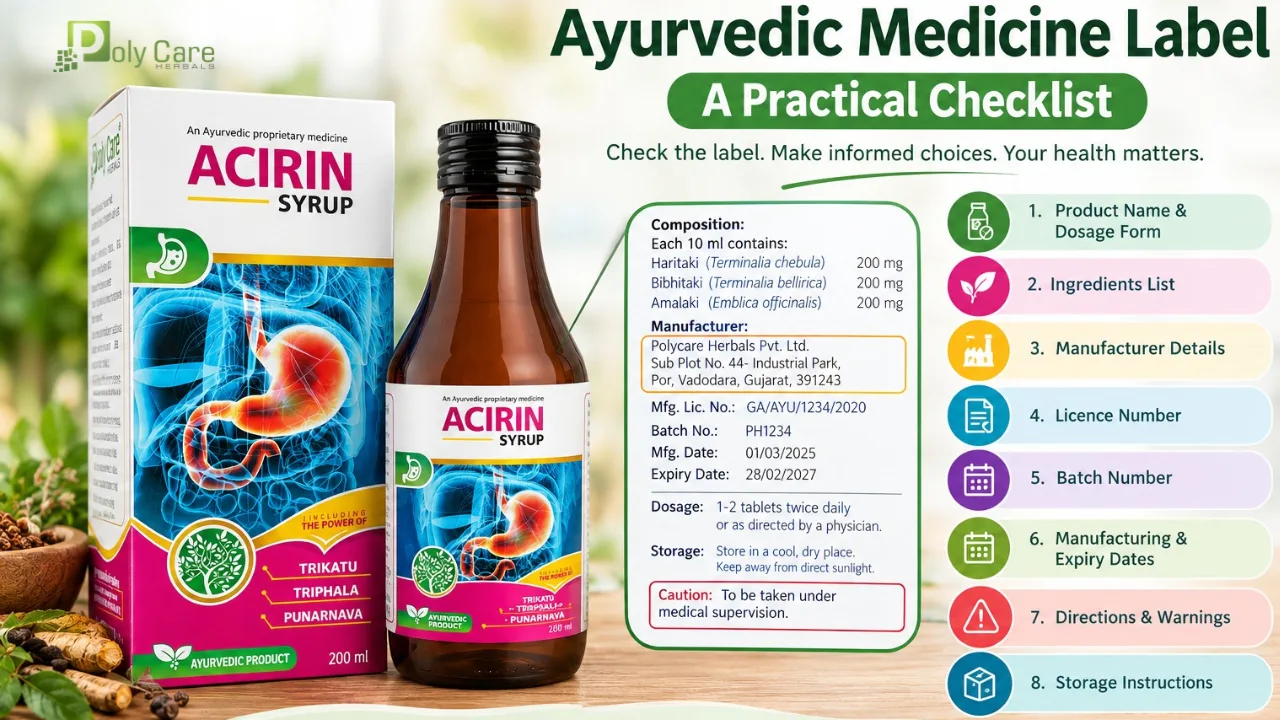
Ayurvedic medicines are available in different forms, including tablets, capsules, syrups and powders. When choosing a product, consumers often focus on its brand name or ingredients. However, the label contains other important details that can help you identify the product, check its expiry date and understand relevant precautions.
Knowing how to read an Ayurvedic medicine label is a practical step towards making informed decisions. This guide explains what to look for on Ayurvedic medicine packaging in India.
1. Check the Product Name and Dosage Form
Start by reading the complete name of the medicine. Check whether it is a tablet, capsule, syrup or powder. Similar-sounding product names do not necessarily mean that two medicines have the same ingredients or intended use.
Always identify the exact product before following any directions or asking for advice.
2. Read the Ingredients List
The ingredients list helps you understand what a formulation contains. Applicable Indian labelling rules specify ingredient-disclosure requirements for Ayurvedic medicines, including relevant ingredient names and quantities, subject to the applicable provisions.
What to check:
- Read the complete ingredients list.
- Look for botanical names, plant parts and ingredient quantities where applicable.
- Check whether additional ingredient information is provided in a leaflet.
- Ask a qualified healthcare professional about ingredients that concern you, particularly if you have allergies or take other medicines.
Do not assume that an ingredient is suitable for everyone simply because it is traditionally used in Ayurveda.
3. Verify the Manufacturer's Details
The manufacturer's name and address help you identify the business responsible for manufacturing the medicine.
Check that these details are readable on the packaging. If the information is missing, unclear or inconsistent, contact the seller or manufacturer for clarification.
Remember that a manufacturer's name alone does not establish that a product is effective or suitable for your individual needs.
4. Look for the Manufacturing Licence Number
Applicable Ayurvedic medicine labelling rules require the manufacturing licence number to be displayed in the prescribed manner.
In India, the relevant State Licensing Authority handles manufacturing licences for Ayurvedic medicines. A manufacturing licence should not be misrepresented as an individual product approval granted by the Ministry of AYUSH.
If you need to verify a licence, contact the relevant authority or ask the manufacturer for clarification.
5. Check the Batch Number
The batch or lot number identifies a particular production batch and supports product traceability.
Before using a medicine, check that the batch number is readable. Keep the packaging or take a photograph of the label if you need to contact the manufacturer about a product-related concern.
A batch number helps identify the product's production batch, but it does not independently prove its quality.
6. Check the Manufacturing and Expiry Dates
Always check the expiry date before using an Ayurvedic medicine. Applicable Indian rules address expiry-date labelling and prohibit the circulation of covered Ayurvedic medicines after expiry.
Remember these points:
- Do not use a medicine after its stated expiry date.
- Check that the date is readable and has not been altered.
- Follow the storage instructions on the package.
- Do not assume that all Ayurvedic formulations have the same shelf life.
If the expiry date is unclear, ask the manufacturer or a qualified healthcare professional for guidance.
7. Read Directions and Safety Warnings
Different products may have different directions and precautions. Never estimate the dose of one medicine based on another product, even if both contain a familiar herb.
Read the directions and warnings carefully. Certain Ayurvedic medicines containing ingredients listed in Schedule E(1) are subject to a specific caution statement under the applicable rules.
Ask a qualified healthcare professional about using a medicine during pregnancy or breastfeeding, for children, or alongside other medicines. If instructions are unclear, seek clarification instead of guessing.
8. Be Careful With Product Claims
Packaging may describe ingredients, traditional uses or intended benefits. However, promotional claims should not be treated as proof of guaranteed results.
The Ministry of AYUSH has cautioned against claims such as “100% safe,” “free from side effects,” “guaranteed treatment” and “permanent cure.”
Do not assume that every Ayurvedic medicine is free from side effects or interactions. A responsible product description should provide clear information without promising outcomes that cannot be guaranteed.
9. Check Storage Instructions and Packaging
Read the storage instructions and follow them carefully. Before using the product, check the container and packaging for damage, leakage, broken seals or signs of tampering.
If the packaging appears damaged or the product's condition is questionable, do not use it until the concern has been resolved with the seller or manufacturer.
Keeping a photograph of the label can also be helpful if you need to ask a question about the product later.
Quick Ayurvedic Medicine Label Checklist
Before using an Ayurvedic medicine, check the following:
- Product name and dosage form
- Ingredients list
- Manufacturer's name and address
- Applicable manufacturing licence number
- Batch or lot number
- Expiry date
- Directions and relevant warnings
- Storage instructions
- Packaging condition
This is a practical consumer checklist, not a complete legal compliance checklist for manufacturers. Specific labelling requirements can vary according to the product and applicable regulations.
Frequently Asked Questions
Check the product name, ingredients, manufacturer's details, manufacturing licence number, batch number, expiry date, directions and relevant warnings.
It helps identify a particular production batch and is useful when contacting the manufacturer about a product concern.
No. Do not use a medicine after its stated expiry date. Ask a qualified healthcare professional or the manufacturer if you need further guidance.
No. It is not appropriate to assume that every Ayurvedic medicine is free from side effects or interactions. Ask a qualified healthcare professional about your specific circumstances.
Contact the manufacturer or seller for clarification. If you are unsure about the medicine's suitability or directions, consult a qualified healthcare professional before using it.
Final Thoughts
Reading an Ayurvedic medicine label carefully helps consumers identify a product, understand its ingredients, check its expiry date and recognise important precautions. Clear product information and responsible communication are important parts of consumer trust.
At Polycare Herbals, we believe consumers should have access to clear and useful product information. Always read the specific product label and seek professional advice when you have questions about your individual needs.
References
- Drugs and Cosmetics Rules, 1945 — CDSCO
- Ministry of AYUSH
- Google Search Central — Creating Helpful, Reliable, People-First Content
000 words Approximately 1 Ayurvedic medicine batch number Ayurvedic medicine expiry date Ayurvedic medicine ingredients list Ayurvedic medicine label information Ayurvedic medicine safety checklist Ayurvedic product label India depending on how your website counts headings and checklist items how to read an Ayurvedic medicine label


